I was recently asked by Jo Morgan at Engendering Change if I would provide a response to the OFCOM’s consultation document on guidance for a safer life online for women and girls. A guidance document that asks owners and developers as well as hosts of Apps and platforms to make sure they consider the ways to keep women and girls safer from the disproportionate harms that they face online from sexist and misogynistic content.
I was delighted to do so and here is my feedback:
Question 1: Do you have any comments on our proposed approach to ’content and activity’ which ‘disproportionately affects women and girls’?
The approach is essential – with the normalisation of misogynistic behaviour and narratives online, filmed ‘pranks’ (harassment), AI deepfakes, location tracking and tools as well as increased intimate image abuse there’s a definite need to focus on the harms that disproportionately affect women and girls (this is also virtually all perpetrated by men and boys).
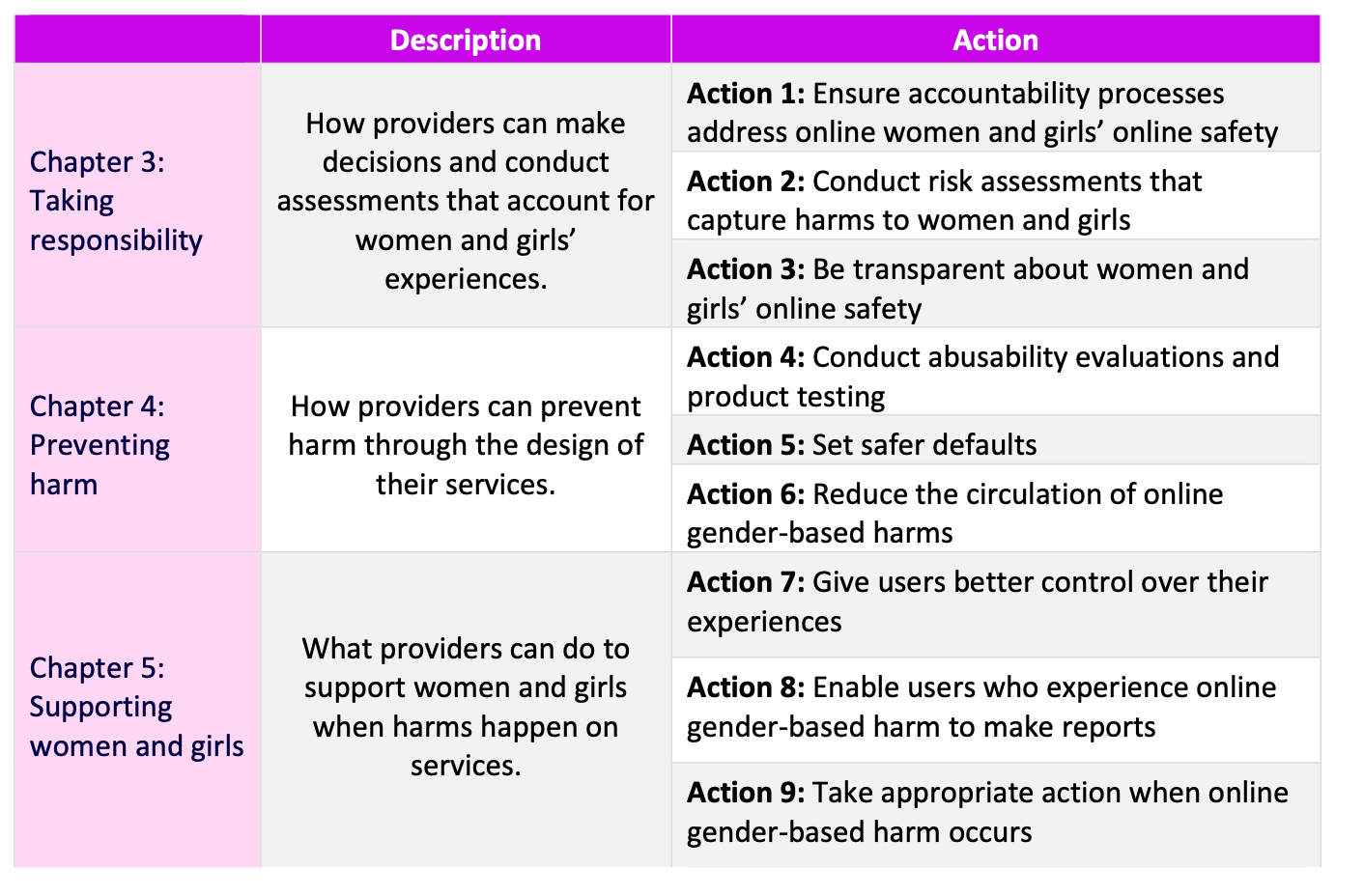
Question 2: Do you have any comments on the nine proposed actions? Please provide evidence to support your answer.
The nine actions are relevant and important steps to be taken in not only the governance and design stages but also in the user experience and the protections thereof.
Question 3: Do you have any comments about the effectiveness, applicability or risks of the good practice steps or associated case studies we have highlighted in Chapter 3, 4 and 5? Are there any additional examples of good practices we should consider? Please provide evidence to support your comment. (SEE BELOW FOR OUTLINE GRAPHIC).
Taking Responsibility: We have seen platforms such as Meta and X (Twitter) remove moderators and other user protections in the name of ‘freedom of speech’ of late and this is making social media less safe for women and girls. The Girlguiding research from 2023/4 shows that girls are more anxious / harassed online and in public. They also feel less confident about themselves due to online pressure.
Inadequate protections online often come as a result of reducing moderation and we have seen that governments (as well as social media companies) can restrict access to apps and content (The USA switched TikTok access off in 2025) so keyword suppression and harmful content human and AI filters should be technologically possible.
An element of Governance has to be proper age verification to ensure certain content isn’t accessible by minors and that they are not negatively-harmed by inappropriate, violent or misogynistic content.
Preventing Harm: This is an area which needs far more focus – both from governance and design points of view as well as an educational approach.
User testing to see how software can be utilised maliciously is vital in the early stages of development and then when launched, ‘white label’ testing where clean devices are given profiles of young men and women are used to test algorithmic activity, AI assistant design and the content that is thrown out to both women and girls and men and boys to assess for different / gendered experiences. Feedback from these exercises must be made public and taken seriously by the owners and developers of any App or platform AND any adaptations required to make users safer MUST be applied BEFORE launch. Licenses to launch should be contingent on proving the safety and rigour of the testing / system controls in place in development.
Default settings for Apps should be in their ‘locked down’ option – so the user has to actively turn on assets like ‘location services’ to ensure it is done consciously. Perhaps also pop-up / agree-to warnings are given about each option which provides information about the consequences of choosing ON or OFF on a particular feature?
Reduce / remove the options for location tagging and private messaging on gaming software / children’s Apps and where it occurs ONLY known users can send text-based messages.
Consider the removal of anonymity for people in certain Apps / platforms because research has shown that anonymous users feel emboldened and disinhibited when using fake / anonymous accounts and according to the Australian Government’s eSafety Commissioner this increases abuse and criminal activity whilst virtually shielded from accountability. Perhaps Apps designed for use by children should have parental identity confirmation built in to the sign-up process?
Supporting Women and Girls: the following suggestions are about empowering women and girls effectively to have recourse and be able to take action themselves when confronted by harmful behaviour or content.
Block and Mute must be a minimum safety precaution on all Apps and platforms.
Reporting systems must be active in reducing harms and applying consequences for harmful behaviours – when women and girls report abusive / misogynistic / threatening content it must be acted upon immediately, by AI tools which can spot patterns of harm and suspend user tools and / or escalate consequences quickly, or by human moderators able to spot nuance and abusive patterns in user behaviours towards women and girls.
Training for human moderators in patterns of grooming and controlling behaviours so that they can effectively spot and take action on accounts that perpetrate these harms.
Effective controls on abusive and dangerous users including referrals to police and law enforcement.
Parental training from social media users to educate parents and guardians on the potential harms their children could be exposed to when online using X, Y or Z Apps and platforms…and exploring the reasons for parental controls on WiFi / home internet systems.
Question 4: Do you have any feedback on our approach to encouraging providers to follow this guidance, including our proposal to publishing an assessment of how providers are addressing women and girls’ safety? Do you have any examples or suggestions of other ways we could encourage providers to take up the ‘good practice’ recommendations?
There could be a Traffic Light / Ratings system for Apps / Platforms which could be hosted by OFCOM and based on User-Safety approaches taken by the providers. Apps could be ranked in age-related / themed ways and have six-monthly reporting systems that allow parents to see which Apps that their children are using are ranked as safest and the suggestion that those below 3/5 or amber-or-below aren’t safe enough. These tools could be part of App Store ranking systems also.
Question 5: Do you have any comments on our impact assessment, rights assessment, or equality impact assessment? Please provide any information or evidence in support of your views.
It is vital that companies producing apps and hosting platforms are held accountable for the way users can utilise their systems. The impact assessment isn’t purely financial but should be taken holistically in terms of their impacts on the safety and wellbeing of users. The OFCOM approach is a sound way of trying to ensure profit-making companies are held accountable for their products’ impacts on women and girls’ lives. It has been proven that women and girls’ online lives are subject to a range of harms and although a voluntary code, it is vital that hosting platforms and App developers use some of their profits to safeguard users – especially when they may be disproportionately harmed by other users on those platforms.
ENDS.